
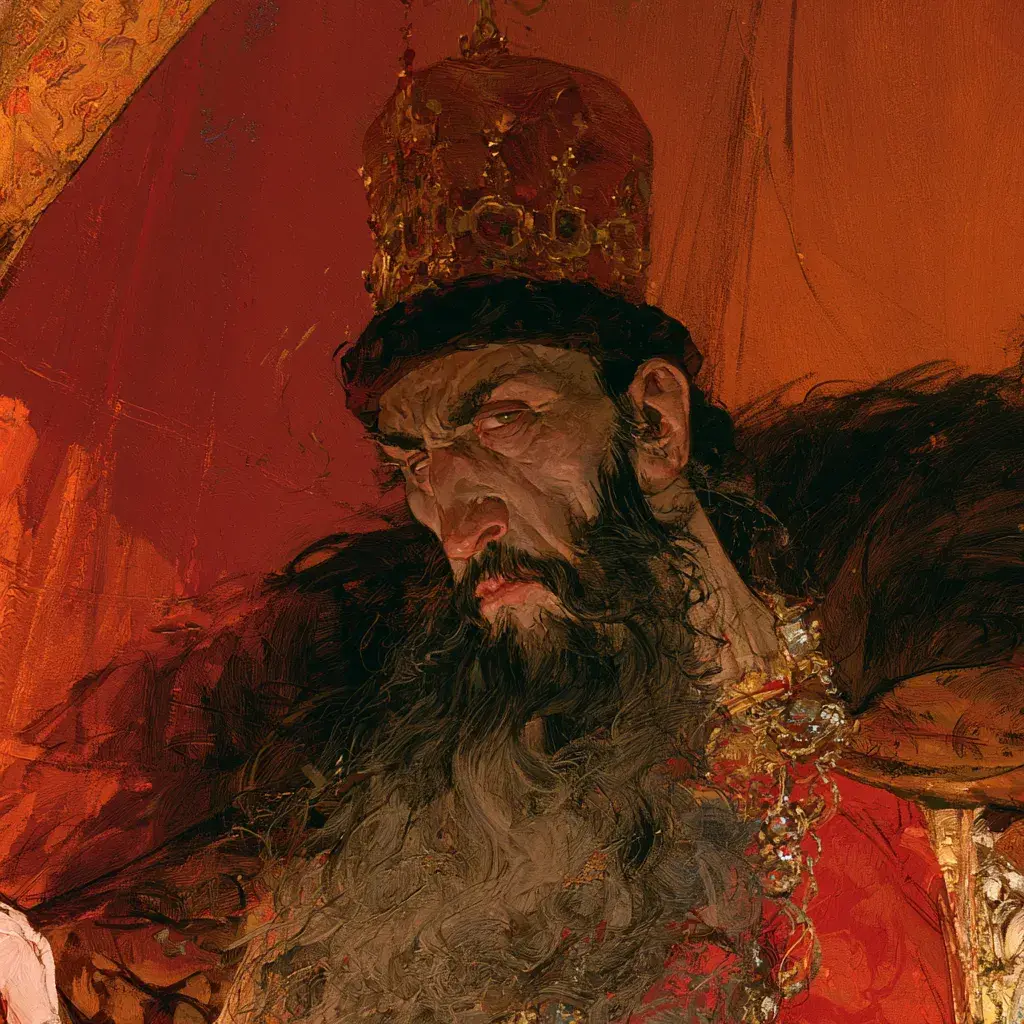
In January 1547, sixteen-year-old Ivan IV stood inside Moscow’s Assumption Cathedral for a ceremony of immense significance. He was not being crowned a prince, but as the first ‘Tsar’ of all Russia. The head of the Russian Orthodox Church, Metropolitan Macarius, placed the ancient Monomakh's Cap on Ivan's head. This sable-trimmed crown was a powerful symbol, elevating the ruler of Moscow above all other Russian princes. The title Tsar signaled a new kind of authority, that of a divinely ordained emperor. Eighteen days later, on February 3, 1547, Ivan married Anastasia Romanovna, making her the first Russian Tsaritsa. The young ruler’s reign had officially begun.
Ivan the Terrible
The life of Ivan IV, Russia's first crowned tsar, from his early reforms and the conquest of Kazan to the Oprichnina terror, the sack of Novgorod and the killing of his own heir.
Chapter 1
The First Tsar
0:42
People in this story
Part of
Frequently Asked Questions
Why was Ivan called 'the Terrible'?
The Russian epithet 'Grozny' is more accurately translated as 'Formidable,' 'Awesome,' or 'Dreaded.' In the 16th century, this conveyed a sense of respect and fear for a powerful, divinely ordained ruler, not necessarily cruelty, though his later actions certainly fit the modern meaning.
What was the Oprichnina?
The Oprichnina was a territory and a state-within-a-state created by Ivan in 1565, ruled directly by him. It was policed by his private force, the Oprichniki, who used terror and violence to crush opposition to the Tsar's absolute power.
What is the significance of St. Basil's Cathedral?
Ivan the Terrible commissioned the cathedral to celebrate his 1552 conquest of the Khanate of Kazan. Its unique and spectacular design was intended to be a powerful symbol of Russian victory and its emergence as a major empire.
Learn more
To continue the story, download the Chunks Microlearning app
Or get it straight away:
 Download on iOS
 Download on Android